Aerogel is an ideal insulating solution for certain industrial applications, including space-constrained applications with low clearances, as they provide a high R-value in a lightweight profile. The material is also effective for protecting light or fragile components that could be damaged by heavier insulation materials.
Firwin Corporation provides custom industrial insulation solutions, including Aerogel thermal insulation, for challenging applications in the power generation, data center, oil and gas, marine, and other industries.
Learn more about the applications, chemical composition, and benefits of Aerogel thermal insulation.
Applications of Aerogel Insulation
Applied in thin layers, Aerogel thermal insulation is best for equipment operating at temperatures up to 1,100 °F in compact spaces. These lightweight materials can also protect fragile components that would otherwise suffer damage from heavier insulating materials. The marine, aerospace, and power generation sectors rely on Aerogel for tight engine rooms and crowded mechanical compartments.
However, space constraints alone do not necessitate the use of Aerogel. Depending on thermal performance needs, a thin layer of fiberglass or superwool may be sufficient for basic thermal insulation requirements. An insulator like Aerogel becomes necessary when the project demands a level of thermal performance that would normally require much thicker insulation than the available physical space allows.
For extremely low-temperature applications, including cryogenic and sub-zero processes, aerogel insulation can be engineered to perform reliably in these conditions.
How Aerogel Performs Compared to Other Insulation Types
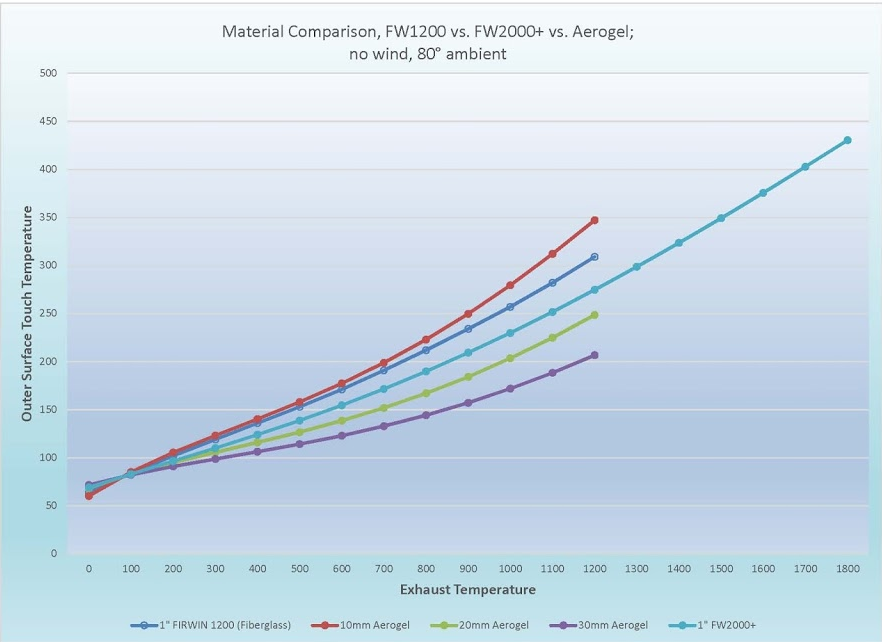
Aerogel can provide advanced thermal insulation within minimal spatial footprints. A thin 10 mm (approximately 0.4 inches) layer of Aerogel insulation delivers thermal effectiveness nearly equivalent to a standard 1-inch thick fiberglass insulation blanket. These two options also offer comparable outer surface touch temperatures to minimize burn risks to surrounding personnel. With Aerogel, facility managers can maximize heat retention and worker protection even within confined spaces.
This chart compares the performance of different Aerogel thicknesses (10 mm, 20 mm, and 30 mm) with that of 1” Firwin 1200 and 1” Firwin 2000+ insulation blankets:
Chemical Composition of Aerogel Insulation
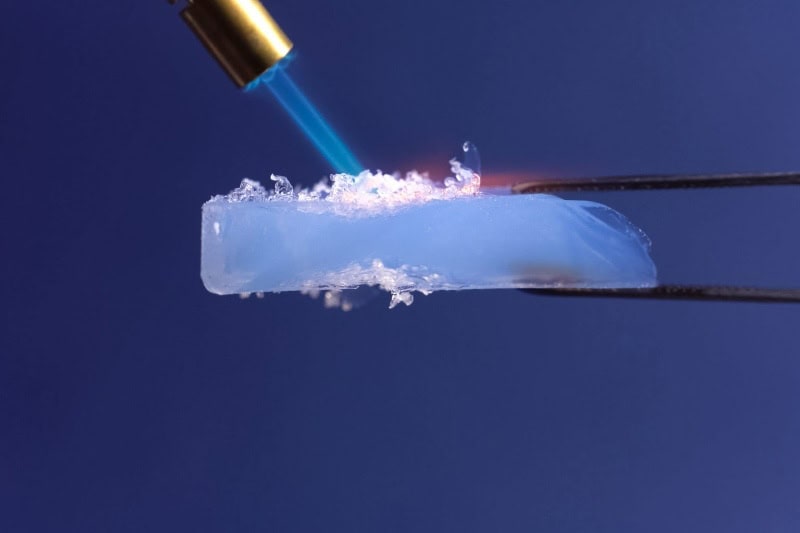
Aerogel is a low-density, high-porosity, solid gel, which has had the liquid replaced by air or gas. This feature is particularly well-suited to thermal insulation, as air is a poor conductor of heat. It provides a reliable barrier against extreme industrial temperatures without adding significant weight to the mechanical assembly. Aerogel’s high gas content also gives it a nearly transparent appearance.
Most Aerogel products are composed of silica, but other materials can be used to create Aerogel’s structural framework, such as:
- Carbon
- Iron oxides
- Copper
- Gold
- Organic polymers
Benefits of Aerogel Insulation
Aerogel thermal insulation solves complex thermal challenges in harsh industrial environments through the following key benefits:
- Versatility. Aerogel can be used as part of an insulation blanket—with a separate liner and outside cover—or as an insulation material on its own.
- Performance efficiency. Aerogel can achieve a greater temperature decrease with a thinner volume.
- Ease of maintenance. As a thinner material, it is easier to install, remove, and replace for inspection and maintenance.
- Energy efficiency. As thermal insulation, it helps improve energy efficiency and reduce energy costs.
- Hydrophobic properties. The material repels water, protecting the operating components and insulation from moisture damage and corrosion.
- Durability. Unlike other materials that can sag, clump, or crack, Aerogel resists mechanical shock and vibration without losing its insulating properties or shape over time.
- Low-temperature performance. Aerogel can be used to insulate complex cryogenic and sub-zero processes.
Contact Firwin for Aerogel and Other Specialized Insulation Solutions
Selecting the correct thermal insulation protects your workforce and extends the life of your industrial equipment. Firwin Corporation designs custom insulation solutions such as Aerogel and Cryogel to address low-clearance, space-constrained thermal challenges. Our facility is ISO 9001:2015 certified, and we hold UL 2200 certification for select products. Contact our team for personalized guidance in selecting an insulation product, or request a quote for a specific solution.